

Appendix A: Technical Information
defibrillator
Heart Save myPAD Semi-Automatic External Defibrillator Heart Save myPAD Fully Automated External Defibrillator
Biphasic cutoff index, automatically compensated for impedance based on the patient.
Selectable output energy for adults: 150 J, 170 J, 200 J
Children: 50 J
Level 1: 150 J
Level 2: 170 J
Level 3: 200 J
Level 1: 50 J
Level 2: 50 J
Level 3: 50 J
The energy configuration of the next energy level must be greater than or equal to the energy of the previous energy level.
It meets the ERC Guidelines 2021 and AHA Guidelines 2020 by default.
Provide energy accuracy
| model | impedance | Energy (J) | ||||||
|---|---|---|---|---|---|---|---|---|
| 26Ω | 50Ω | 75Ω | 100Ω | 125Ω | 150Ω | 175Ω | ||
| Children's way | 50J | 43 | 50 | 52 | 52 | 52 | 50 | 48 |
| 150J | 128 | 150 | 155 | 157 | 159 | 160 | 158 | |
| Adult way | 170J | 147 | 170 | 178 | 184 | 188 | 189 | 184 |
| 200J | 173 | 200 | 209 | 216 | 222 | 223 | 217 | |
The tolerance in the data is ±15%.
Waveform parameters (200J)

The legend shows the waveform time parameters T1 to T35.
Waveform parameters (170J)

| impedance | I1/A | T1/ms | T2/ms | Energy/J |
|---|---|---|---|---|
| 25Ω | 59 | 2.8 | 2.8 | 147 |
| 50Ω | 35 | 4.1 | 4.1 | 170 |
| 75Ω | 25 | 6.3 | 4.3 | 178 |
| 100Ω | 19 | 8.4 | 5.6 | 184 |
| 125Ω | 16 | 10.4 | 7 | 188 |
| 150Ω | 13 | 12 | 8 | 189 |
| 175Ω | 11 | 12 | 8 | 184 |
Waveform parameters (150J)

| impedance | I1/A | T1/ms | T2/ms | Energy/J |
|---|---|---|---|---|
| 25Ω | 55 | 2.8 | 2.8 | 128 |
| 50Ω | 32 | 4.5 | 4.5 | 150 |
| 75Ω | twenty three | 6.3 | 5.0 | 155 |
| 100Ω | 18 | 8.0 | 5.3 | 157 |
| 125Ω | 14 | 9.7 | 6.4 | 159 |
| 150Ω | 12 | 11.5 | 7.7 | 160 |
| 175Ω | 11 | 12.0 | 8.0 | 158 |
Waveform parameters (50J)

| impedance | I1/A | T1/ms | T2/ms | Energy/J |
|---|---|---|---|---|
| 25Ω | 32 | 2.8 | 2.8 | 43 |
| 50Ω | 19 | 4.5 | 4.5 | 50 |
| 75Ω | 13 | 6.3 | 5.0 | 52 |
| 100Ω | 10 | 8.0 | 5.3 | 52 |
| 125Ω | 8 | 9.0 | 6.0 | 52 |
| 150Ω | 7 | 9.0 | 6.0 | 50 |
| 175Ω | 6 | 9.0 | 6.0 | 48 |
Charging duration
Preservation parameters of the heart for the first charge impact:
- New Battery 3C
From opening to charging at 150/200 J: completed in no more than 17/22 seconds.
From AED analysis to charging to 150/200 J completed: no more than 8/12 seconds - New battery 3G
From switching on to charging (150/200 J): completion time no more than 13/16 seconds. From AED analysis to charging (150/200 J): completion time no more than 5/8 seconds. - After 3C testing, the battery discharges 15 times its maximum energy from switching on to charging at 150/200 J in no more than 17/22 seconds.
From AED analysis to charging to 150/200 J completed: no more than 8/12 seconds - After the battery reaches 3G, the maximum energy discharge of 15 times is completed from power-on to charging at 150/200 J in no more than 13/16 seconds. Analysis by the AED shows that the charging process from 150/200 J to charging is completed in no more than 5/8 seconds.
25 - 200Ω
electrode
Sheng Medical Co., Ltd.
Save pad plus C - OBS-DE/P303A1206 (for adults and children without CPR feedback sensor)
SavePads with CS - OBS-DE/P303A1207 (for adults and children with CPR feedback sensor)
Up to 48 months + 12 months shelf life (backup life verified at 25°C; higher ambient temperatures may reduce life).
Total area: 117 ± 10 cm²
Effective area: 86 ± 10 cm²
Cable length: 1.40 ± 0.2 m
Maximum number of defibrillation thrusts: 50 thrusts
Electrode placement depends on the patient's age. See Section 7.5.2 for details.
One cable connection (only applicable to electrodes with CPR feedback sensors)
The preparation of the edited links is underway.
Battery
| Battery Model | Battery Type | Specification |
|---|---|---|
| Battery 3C (NRL03C) | LIMnO₂, non-rechargeable | 12V, 2.8 Ah |
| Battery 3G (NRL03G) | Lithium-ion, rechargeable | 14.4V, 2.95 Ah |
Backup life
Battery 3C: Up to 48 months + 12 months warranty conditions: The device is powered by a new battery with an ambient temperature of 20°C ± 5°C, performs a weekly self-test, and is not powered on or connected to the network.
Battery 3G: Maximum service life of 12 years. Conditions: The device is powered by a new battery with an ambient temperature of 20°C±5°C, performs a weekly self-test, is not powered on, has no network connection, and has no more than 500 charging cycles.
runtime
Battery 3C: Operate for 9 hours with a new battery at an ambient temperature of 20°C±5°C, without defibrillation charging or discharging, with volume set to low and display brightness set to indoor.
Battery 3G: Operate for 14 hours with a new battery at an ambient temperature of 20°C±5°C, without defibrillation charging or discharging, with volume set to low and display brightness set to indoor.
Discharge performance
Battery 3C: 130 times 200 J discharge, ambient temperature 20℃±5°, voice volume set to low, display brightness set to indoor.
Battery 3G: 230 times 200 J discharge, ambient temperature 20℃±5°C, voice volume set to low, display brightness set to indoor.
After the shelf life under safe storage conditions, the battery for 3C devices is expected to withstand approximately 6 times the impact. The battery for 3G devices, when fully charged, is expected to withstand more than 6 times the impact.
When the remaining battery power is low, the device will display a "Low Battery Power" message when turned on. The device can be left in standby mode for more than one month.
The device can perform at least 10 discharges of 150J or 6 discharges of 200J, followed by 40 minutes of operation. (The device is powered by a battery at 20°C ± 5°C). If recharging is no longer possible, the device will automatically switch to CPR mode.
CPR Feedback Guidelines
Compression frequency range: 100-120 cpm.
Compression accuracy frequency: ±3cpm.
Compression depth range: 50-60 mm.
Compression depth accuracy: ±5 mm or ±10%, whichever is greater.
USB Specification
USB ports: 1 USB
Electrode socket: Serial communication port
Wireless LAN specifications (if any)
WLAN standard: IEEE 802.11 b/g/n
Frequency: 2.4 GHz Maximum radiated output power: 20.5 dBm EIRP (RF power, including maximum antenna gain (3.37 dBi))
Wireless transmission rate: up to 150 Mbps
LTE specifications (if any)
aisle:
LTE-FDD: B1/B3/B7/B8/B20/B28A
LTE-TDD: B38/B40/B41
Transmission power:
LTE-FDD: 23±2 dBm
LTE-TDD: 23±2 dBm
Standard: 3GPP E-UTRA Version 11
monitor
Color LCD screen (only applicable to 675, 675A)
Touchscreen LCD display (678, 678A only)
Car, indoor, outdoor (the monitor brightness automatically adjusts according to ambient light)
Size: 4.3 inches (10.9 cm)
Resolution: 800 x 480
Data storage
| Data types | capacity |
|---|---|
| electrocardiogram waveform | 1 channel |
| Internal storage | 8GB |
| ECG waveform events | 160 hours |
| Event Log | 10,000 events |
| Audio Log CPR | 32 hours |
| Data self-inspection report | 160 hours, at least 3650 reports |
| Log data | 100,000 events |
MYPRIMEDIC Configuration Application
| Require | iOS | Android |
|---|---|---|
| CPU | 2.5 GHz | 2.0 GHz |
| RAM | 3 GB | 6 GB |
| storage | 64 GB | 64 GB |
| monitor | 1792 x 828 | 2408 x 1080 |
| operating system | iOS 14 | Android 11 |
Safety category label
Devices with internal power supply, defibrillator type high-intensity ignition
The product bears the CE mark, indicating that it complies with the provisions of the Medical Devices Regulation (EU) 2017/745 concerning medical devices and meets the essential requirements of Annex I to this Directive.
Environmental Standards
Operating conditions
Temperature: -5°C to 55°C
Humidity: 0 to 95%, but no condensation; Pressure: 540 hPa to 1062 hPa
(If the device was previously stored in a suitable environment, it can operate at -20°C for at least 20 minutes.)
Short-term transport and storage conditions (<1 week)
Temperature: -30°C to 70°C
Humidity: 0 to 95%, but no condensation; Pressure: 510 hPa to 1062 hPa
Long-term transportation and storage conditions (>1 week)
Temperature: -5°C to 55°C
Humidity: 0 to 95%, but no condensation; Pressure: 510 hPa to 1062 hPa
size
670, 671, 670A, 671A: 151 mm x 151 mm x 73 mm (±2 mm)
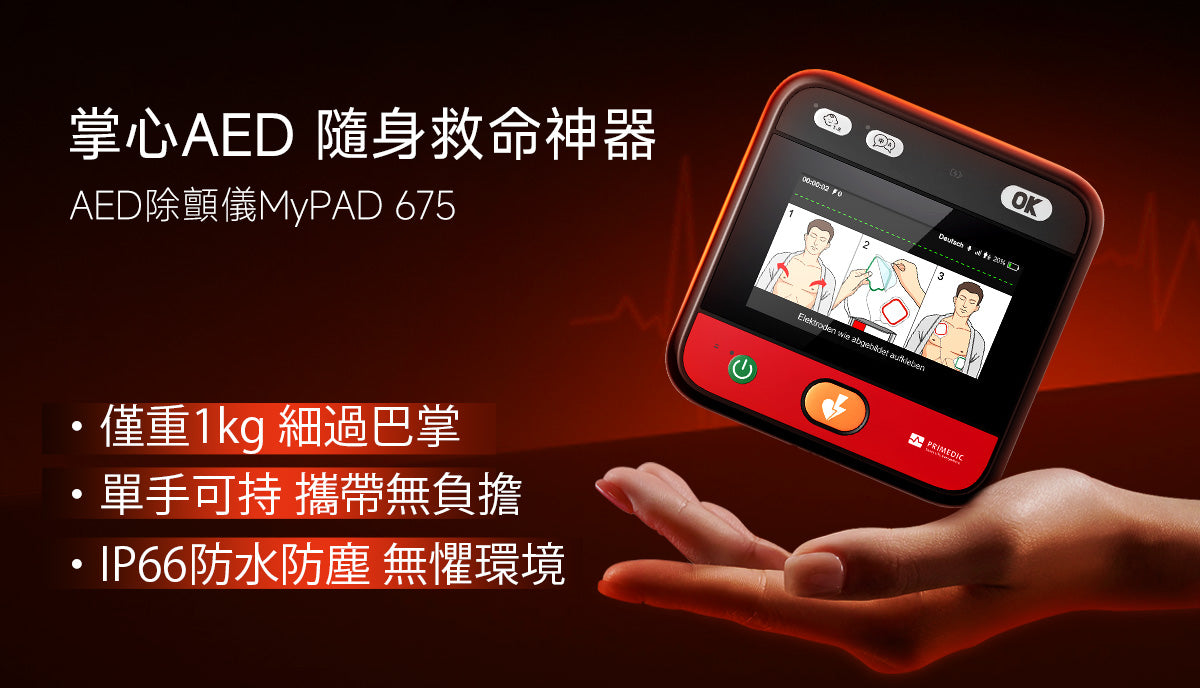
675, 678, 675A, 678A: 151 mm x 151 mm x 76 mm (±2 mm)
weight
670, 671, 670A, 671A: Approximately 1.0 kg (±0.2 kg)
675, 678, 675A, 678A: Approximately 1.1 kg (±0.2 kg)
Minimum lifespan of the combined device, electrodes, and battery
For at least 4 years, the temperature is between 15°C and 35°C, the humidity is 80%, and the air pressure is between 540 hPa and 1060 hPa.
Test Standards
Drop test: Test height 1.6m
Impact testing: Compliant with IEC 60601-1-12:2014+AMD1:2020 and IEC 60601-1-11:2015+AMD1:2020 CSV
Vibration test: Compliant with IEC 60601-1-12:2014+AMD1:2020 and IEC 60601-1-11:2015+AMD1:2020 CSV
Software Information
AED Embedded Software (Version: 01.00.00.00)
Appendix B: Warranty
During the 8-year warranty period, the manufacturer will remedy any defects in the equipment free of charge if the defects are due to material or manufacturing errors. The equipment can be restored to its original functionality as selected by the manufacturer through repair or replacement.
Claims under the warranty will not extend the original warranty period.
Warranty and legal warranty claims do not apply if the use of the equipment is only noticeably affected, or due to normal wear and tear, or due to improper or negligent handling, excessive wear, or special external effects not specified in the contract. The same applies if the buyer or a third party has performed improper alterations or incorrect repairs.
All other claims against the manufacturer are excluded unless such claims are based on intent or gross negligence or mandatory legal liability standards.
If you have a warranty claim, please return the device to your dealer or manufacturer with proof of purchase (such as an invoice) showing your name and address.
Metrax is happy to provide after-sales service, even after the warranty period has expired.
Appendix C: Rhythm Detection System
The rhythm detection system on the heart preserver can analyze the patient's electrocardiogram and detect rhythms that are either shock-prone or not.
The algorithm
- Filtering interference and detecting artifacts
- Calculate multiple electrocardiogram signal parameters, including frequency and morphological parameters.
- Reject implantable pacemakers and artificial products
Rhythm Category
■ A shockingly fast pace:
Ventricular fibrillation (VF): Amplitude 0.2mV
pulseless ventricular tachycardia (pVT)
■ Non-shock rhythm:
Normal sinus rhythm, supraventricular tachycardia, atrial fibrillation/flutter, sinus bradycardia, unique ventricular rhythm, polyvinyl chloride (extraventricular systole) characteristic sinus rhythm, cardiac arrest.
Rhythm database source:
The ECG evaluation data in the algorithm evaluation database comes from international standard databases. ECG data from each database can be downloaded from https://www.physionet.org. To collect ECG data for different rhythms, we selected the following databases, described below:
- VFDB: MIT-BHI Database of Malignant Ventricular Ectopicities
- CUDB: CU Database of Ventricular Tachyarrhythmias
- MITDB: MIT-BHI Arrhythmia Database
- European ST-T Database
- SVDB: MIT-BHI Supraventricular Arrhythmia Database
- MIT-BHI Atrial Fibrillation Database
- LTAFDB: Long-Term A/F Database
- SDDB: Dynamic Electrocardiogram Database for Sudden Cardiac Death
- Shaoxing: A 12-lead electrocardiogram database for arrhythmia research
- AHADB: American Heart Association Database
- NSTDB: MIT-BHI Noise Stress Test Database
- MDB: Metax GmbH Database
Test results of the device's performance configured with a heartbeat preservation and impact rhythm analysis algorithm. Complies with IEC 60601-2-4 requirements.
The test results for the requirements of IEC 60601-2-4 are shown below.
| Rhythm Category | Require | Test Results |
|---|---|---|
| Shocking (sensitivity) | ||
| Vf | ≥90% | Already approved |
| VT, pulseless | ≥75% | Already approved |
| Non-impact (specific) | ||
| Normal sinus rhythm (NSR) | ≥99% | Already approved |
| ASYS (Area Systole) | ≥95% | Already approved |
| Sinus rhythm, supraventricular tachycardia, sinus bradycardia, atrial fibrillation/atrial flutter, heart block, ventricular voluntary rhythm, pacemaker rhythms with ventricular premature beats (PVC) characteristics. | ≥95% | Already adapted |
| Positive predictive value | Report only | 98.2% |
| false positive rate | Report only | 0.9% |
PRIMEDIC
Saves Life.

Leave a comment
This site is protected by hCaptcha and the hCaptcha Privacy Policy and Terms of Service apply.