


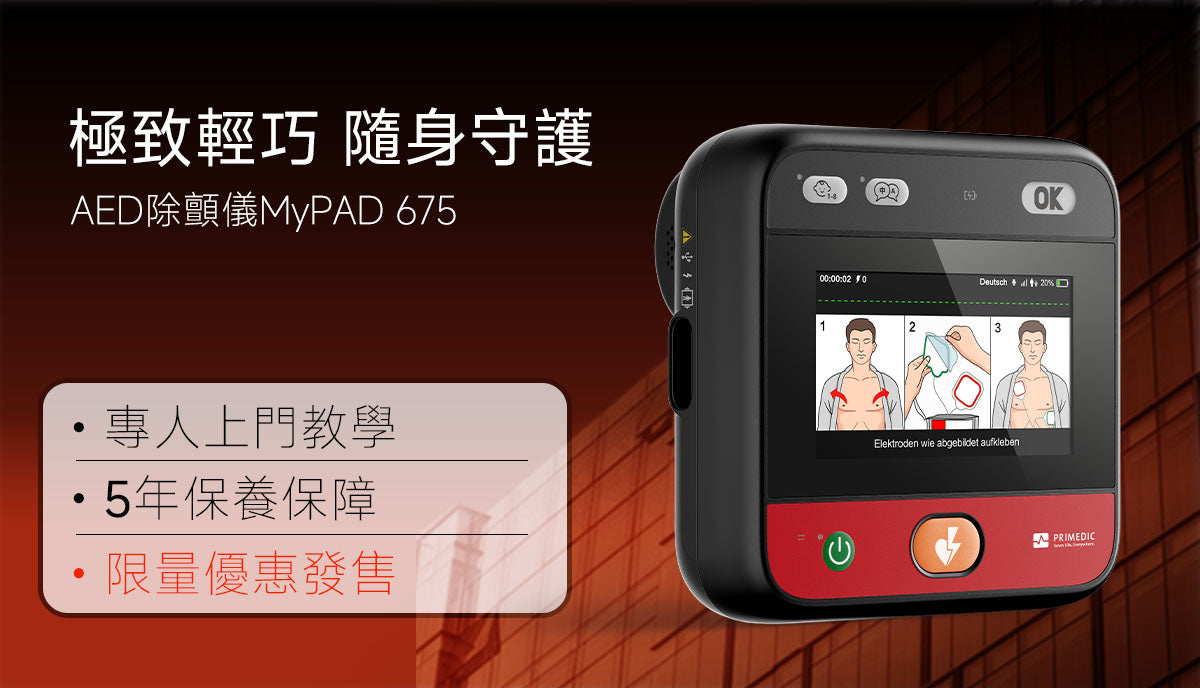
HeartSave myPAD device
Chapter 7 - Equipment Operation and Emergency Procedures
Note: The treatment procedures using this device are performed in accordance with the recommendations of the European Committee for Resuscitation.
Warning: Risk of explosion and burns
Do not use this device in areas with potential blasts.
Do not use this device in oxygen-rich environments.
Do not use equipment near flammable materials.
Warning: Risk of bodily injury and skin burns
Remove hair from the area where the electrodes are placed.
If necessary, dry the skin before connecting the electrodes.
7.1 Examining and preparing the patient
Check if the patient is unconscious or breathing abnormally. Perform the following steps:
- Gently tap the patient's shoulder to alert them to the examination.
- If the patient is unresponsive, check for any signs of breathing.
- If necessary, check the airway for respiratory function.
- Call emergency services
- Start chest compressions and administer defibrillation.
- If you have a defibrillator, turn it on and follow the instructions.
Remove clothing from the chest area and connect the electrodes. If chest hair is covering the area, use the provided razor to remove the hair from the electrode connection points.
If your skin is damp or dry, use the towel provided in the accessory kit.
If there is hair, dust, or dirt on the chest, clean it with the provided towel before connecting the electrodes.
7.2 Examine patient categories
This device is designed for use by adults or children. For patients under 8 years of age or weighing less than 25 kg, please use the child mode of this device.
Note: Treatment should not be delayed to determine the patient's exact age or weight.
7.3 Turn on the device
To turn on the device, press the power button. The device can only provide defibrillation if it detects a shock-prone heart rhythm.
When the device is turned on, the following prompt will be displayed:
The following prompt will appear when the electrodes connected to the device and the electrical pad are connected to the patient:

Figure 10. LCD display when the device is turned on (if any)
If the patient is under 8 years old or weighs less than 25 kg, press the child button to use the child mode for treatment. The sub-mode button will light up when the device is running in sub-mode.
The pediatric mode is for defibrillation of children. This mode provides less impact energy than the adult mode.
7.4 Preparing the Patient
7.4.1 Removing clothing from the patient
Remove clothing from the patient. If chest hair covers the skin, use the provided razor to remove the hair at the electrode placement locations.
7.4.2 Placing the electrodes
step:
- Open the electrode bag.
- Remove the protective foil from one of the electrodes, and then immediately place the electrode in the designated position. (See Figure 13 for adults, Figure 14 for children)
- Then remove the protective foil from the second electrode and place it in the designated location.
Press the electrode carefully to ensure good contact and that there are no air bubbles under the electrode!

Electrode bag schematic diagram

(1) Electrode protective foil
(2) Electrode

Red 1 : In the right chest area, below the collarbone
Green 2 : On the left side of the chest, on the axillary line above the top of the heart.

Red 1 : Back is at the same height as the heart
Green 2 : In the center of the chest
The device provides a voice prompt to guide you in applying electrodes to the patient.
Note: If the electrodes are not connected to the patient after several voice prompts, the device will automatically switch to CPR. See Chapter 8 and the Appendix for details.
When the electrodes are properly applied to the patient, the cardiopulmonary resuscitation commands will be immediately interrupted and the system will switch to rhythm analysis.
Note: The following electrodes should be used for defibrillation.
| manufacture | Product Name | Model | Remark |
|---|---|---|---|
| Bason Medical Ltd. |
SavePads Plus C
|
OBS-DE/P303A1206 | See the appendix for details. |
| Bason Medical Ltd. |
SavePads PLUS CS
|
OBS-DE/P03A1207 | See the appendix for details. |
If the electrodes are not applied correctly, the ECG signal may not be able to be analyzed. In this case, the device will provide a voice prompt:
To avoid the risk of skin burns from damaging the gel layer of the electrodes.
Before connecting the electrodes to the patient, be careful not to touch the gel layer. Caution: damage to the gel layer may cause skin burns.
Do not use expired or damaged electrodes, including damaged electrode bags.
Check validity from the expiration date.
7.5 Perform electrocardiogram analysis
If electrodes are used, the device will automatically begin rhythm analysis.
The patient should be placed in a stable location and should not be touched. The device will provide voice prompts:
The device's algorithm will assess whether a patient's electrocardiogram (ECG) signal requires defibrillation.
If the device detects external interference (e.g., shaking the patient, etc.) affecting the ECG signal, the device will provide a voice prompt:
During the heart rhythm analysis process, the system first filters the original acquired electrocardiogram signal to remove low-frequency baseline drift and high-frequency noise interference, and then further eliminates interference that may be generated in the signal, including patient tremors, breathing, muscle contractions, etc.
Note: The electrocardiogram displayed on the monitor is for identifying the application of electrodes, not for diagnostic purposes.
7.6 Defibrillation
Note: An impact will only be emitted when the impact button is lit and pressed. (For semi-automatic models)
Defibrillation may cause muscle contractions in the patient.
When the device is charged and ready to withstand an impact:
- If the device detects a shock-prone rhythm, it will not discontinue defibrillation.
- If the device detects a non-impact rhythm, it will automatically terminate the defibrillation process.
If the device can clearly identify VF, it will recommend defibrillation.
A continuous tone and an impact button flashing "orange"
Press the impact button promptly according to the voice command.
The impact is delivered automatically, requiring no further action.
Following a shock delivery, the device will continue to provide cardiopulmonary resuscitation (CPR) guidance until the next electrocardiogram analysis.
Defibrillation and cardiopulmonary resuscitation will be repeated according to the instructions in the ERC guidelines.
If the device can't find a shocking rhythm, then you'll hear:
Dangers to users or third parties
Triggered arrhythmias
Before and during defibrillation, all resuscitation participants must stand still and avoid contact with the patient or other potential electrical conductors (e.g., the stretcher).
7.7 Cardiopulmonary Resuscitation (CPR)
The device follows the recommendations of the 2021 ERC guidelines. These guidelines differentiate resuscitation methods for trained and non-trained rescuers. Chest compressions should be performed on a hard surface whenever feasible.
7.7.1 Cardiopulmonary resuscitation by trained rescuers
The 2021 ERC guidelines recommend that trained first responders perform two ventilations after chest compressions. For trained first responders, different procedures are recommended for adults and children. For adults, ERC 2021 recommends alternating 30 chest compressions and 2 ventilations. For children, ERC 2021 recommends alternating 15 chest compressions and 2 ventilations.
In child mode, we provide 15 to 30 chest compressions followed by 2 breaths. To change the configuration, please contact your dealer or our service.
7.7.2 Cardiopulmonary resuscitation (CPR) for non-professional rescuers
According to the ERC 2021 guidelines, untrained adult first responders are advised to perform only continuous chest compressions without ventilation during resuscitation. If the first responder has not received specific training in pediatric basic life support, the ERC 2021 guidelines recommend two chest compressions and two ventilations or continuous chest compressions for children.
or
7.7.3 CPR Configuration of the Equipment
The default CPR configuration is described in Chapter 7.7.1. For changes to the chest compression device configuration, please refer to Chapter 7.7.2. Contact your dealer or our service department.
7.7.4 CPR Metronome Function
During chest compressions, the device provides a metronome function to guide you in performing the correct chest compression rate. Please follow the rhythm.
For the equipment configuration described in Chapter 7.7.1, artificial respiration is also guided by two acoustic outputs.
Note: Once a cardiopulmonary resuscitation cycle is completed, the device begins another cardiac rhythm analysis.
Cardiopulmonary resuscitation (CPR) should always be performed until emergency services arrive.
7.7.5 CPR Feedback Sensor
This chapter applies only to electrodes with CPR feedback sensors.
When connected to a CPR feedback sensor, the device provides voice prompts about real-time compression feedback.
During chest compressions, the device will provide compression quality feedback in voice prompts when you use electrodes with CPR feedback sensors.
Note: Correction tips regarding chest compression depth are only applicable to adult patients in pediatric mode, providing feedback on CPR quality.
Connect CPR feedback sensor
- Place the CPR feedback sensor so that the compression area is located in the middle of the chest, between the nipples.

Figure 15 CPR feedback sensor positioning
Recommended compression frequency: 100-120 / min
- When the compression rate is less than 100 bps, a voice prompt will appear: <Press faster>
- When compression exceeds 120 rpm, a voice prompt will appear: <Press slower>
Recommended compression depth for adults: 5-6 cm
- When the compression depth is less than 5 cm, the voice prompt will say "<Press harder>".
- When the compression depth is greater than 6 cm, the voice prompt will say "Press lightly".
7.8 After use
To turn off the device, you can use:
- Press the power button for approximately 3 seconds. You will hear a beep.
- The device will automatically shut down if it is not connected for 30 minutes.
Note: The device will not automatically shut off when it detects that the electrodes are being applied correctly.
After treatment and use, please keep the device ready for immediate use:
- Check the device for damage after each use.
- Clean the equipment and accessories after each use. If there is a risk of infection, disinfect the equipment and accessories, see Section 13.1.
- Replace the electrodes, check the battery, and replace the battery if necessary.
- If any malfunction or obvious problem occurs, please contact customer service.

Leave a comment
This site is protected by hCaptcha and the hCaptcha Privacy Policy and Terms of Service apply.